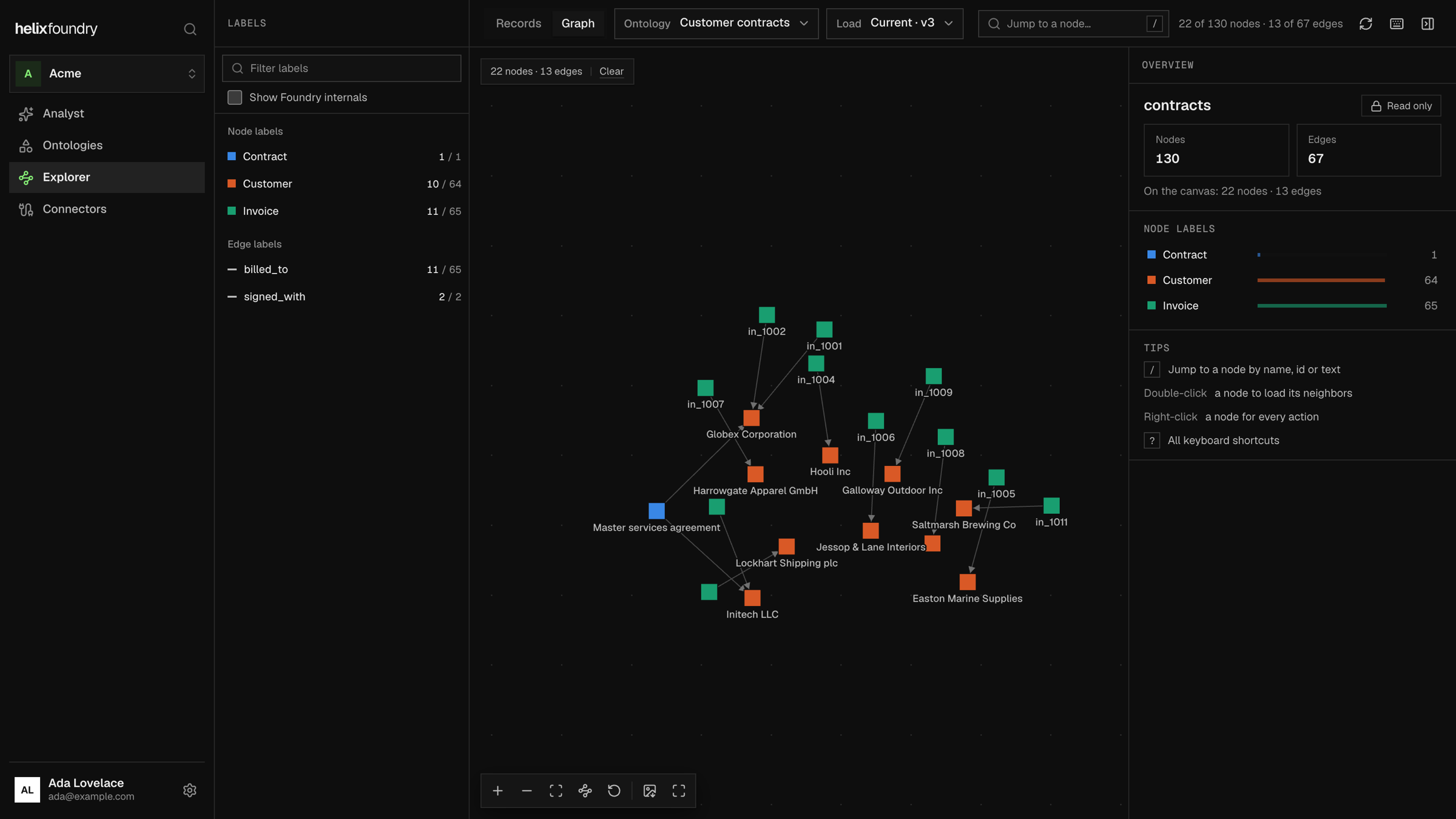
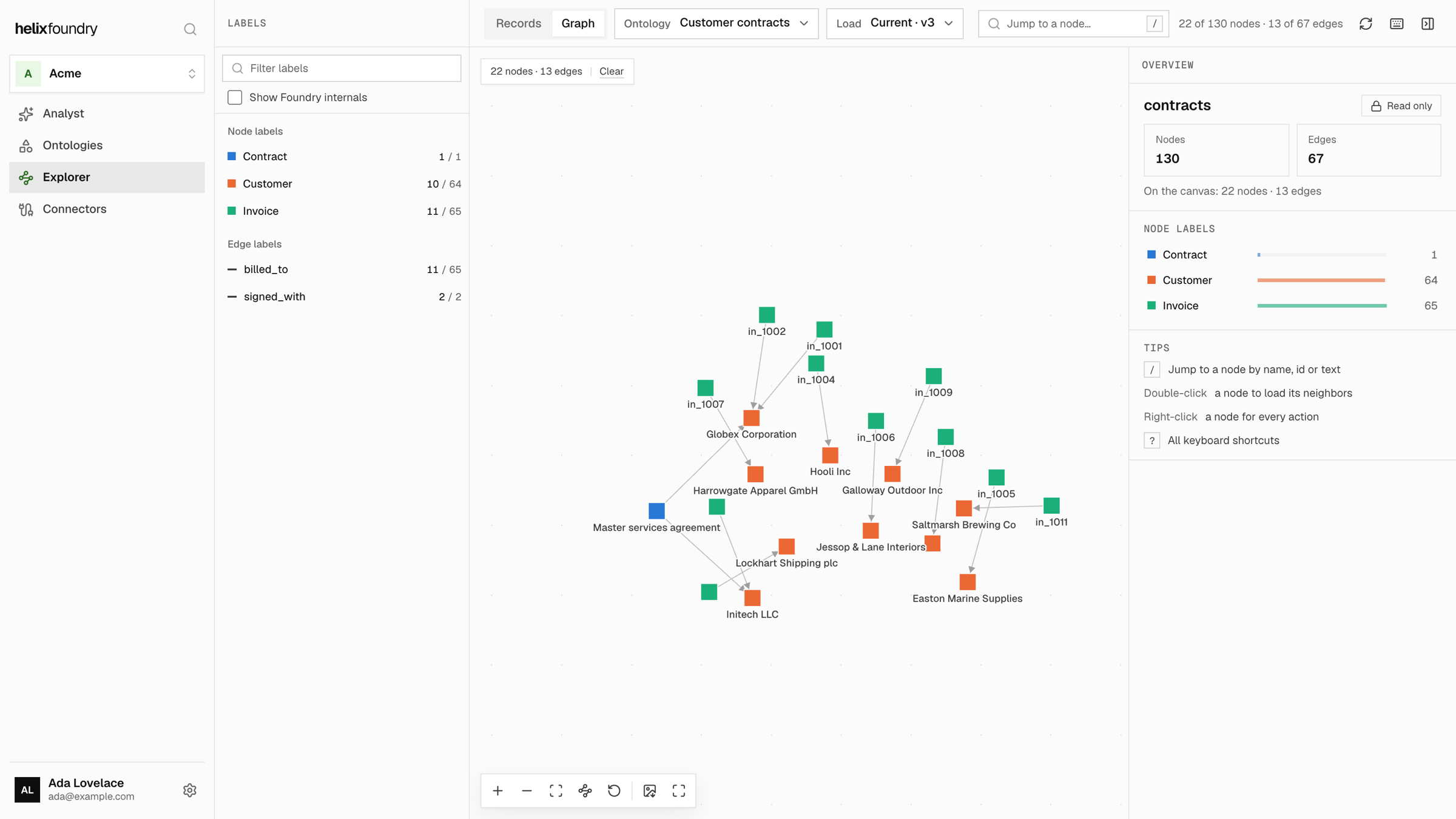
The graph hides what a key can’t read
Anything in the graph built from a source a person or key can’t read is hidden from them: the entities, the facts, and the rules that rely on it. Each sees only the part of the graph their sources fill.
An open-source alternative to Palantir Foundry
Your infrastructure. Your models. Access that follows your data, and an ontology that maintains itself.
Your infrastructure. Your models.
Foundry is built for a bigger screen: open this page on your computer to start.
Book a meetingConnects to the databases, tools and documents you already run












Access
Permissions come from your sources, not a second system to keep in sync.
Anything in the graph built from a source a person or key can’t read is hidden from them: the entities, the facts, and the rules that rely on it. Each sees only the part of the graph their sources fill.
People and groups sync from Microsoft Entra ID or Okta.
A member, team or agent key sees nothing until it's given a source.
Share a connection, a table or a document set, in the app or through the API.
Maintenance
It keeps up as your data changes, without a team rebuilding it.
Deployment
The same Foundry wherever it runs, on whichever model you choose.
High availability and failover wherever it runs.
Your agents can query the graph directly in SQL, Cypher or JSON.
Enterprise
Or get started locally
Try it on your own data, with your own models, before you talk to anyone.
Read the install guideView on GitHubYes. Deploy it on your own Kubernetes, in your cloud account or on-prem, with high availability and failover. Your data stays inside your network.
No. Use any model with your own keys (Amazon Bedrock, Azure OpenAI, Claude, OpenAI or any OpenAI-compatible API), self-hosted models, or none of ours: your own agents query the graph directly over MCP in SQL, Cypher or JSON.
Nothing is visible by default. People and groups sync from Microsoft Entra ID or Okta, access is granted per source, and anything built from a source someone can't read is hidden from them.
Managed change data capture keeps PostgreSQL and MySQL in sync without rebuilding the ontology, a background agent repairs broken links, and low-confidence facts go to review. The ontology itself is code you can edit by hand, by agent or through the API.
Yes. Foundry is open source under Apache 2.0, and the open-source build is the same core, so you can run a proof of concept on your own data first.